
Planning to pursue a graduate degree in another country involves coordinated steps across academic, administrative, and logistical areas. The process typically includes identifying programs that match a candidate's academic background and career interests, reviewing admission requirements such as transcripts and test scores, assembling formal application materials, and preparing for any required language or standardized testing. It also often requires attention to timelines, credential verification, and institutional policies that can vary by country and university.
Preparation for international graduate applications usually combines research with document readiness. Applicants may map program curricula and faculty profiles to assess fit, compare application deadlines and fee structures, and prepare official university transcripts and certificates. Understanding the types of program formats (research-based, taught coursework, professional) and typical duration can help set realistic timelines. Attention to administrative details—translations, notarization, or verification of academic records—can reduce processing delays.

When researching programs, many applicants construct a shortlisting framework to compare curriculum content and assessment methods rather than relying on a single indicator. This framework commonly accounts for expected course modules, research supervision availability for thesis programs, credit transfer policies, and whether the program’s structure aligns with professional or academic goals. Applicants may also note differences in application formats—some programs request detailed research proposals, whereas others focus on portfolios or professional experience—so mapping these requirements in advance can clarify what materials will be needed.
Document preparation often involves collecting certified copies of academic records, a curriculum vitae, statements of purpose, and letters of reference. Translations and notarized documents may be required if originals are not in the host country’s accepted language. Applicants typically check whether institutions accept scanned documents for initial assessment and what must be submitted as certified originals for final enrollment. Timelines for obtaining official transcripts or reference letters can vary, so many planners allow extra time for verification or courier services.
Standardized tests and language assessments are frequently a scheduling factor. Test score validity periods, registration availability, and result release dates may affect application windows; for instance, some language test scores are valid for a limited number of years. Selecting an appropriate test well ahead of application deadlines can permit retakes if necessary. Applicants also often review whether programs accept alternative or in-house language assessments, which can alter preparation plans.
Financial planning and visa considerations commonly shape realistic application choices. Estimating tuition ranges, living expenses, and potential funding sources may influence which programs to prioritize. Visa requirements frequently include evidence of funds, health insurance, and proof of admission, and these conditions can differ by destination. Early familiarity with both financial and immigration processes may help align application timing with external processing periods.
In summary, preparing to pursue graduate study abroad combines program research, document readiness, test planning, and awareness of immigration and financial conditions. These areas often interact, so building a coherent timeline that sequences research, tests, and document verification can reduce last-minute issues. The next sections examine practical components and considerations in more detail.
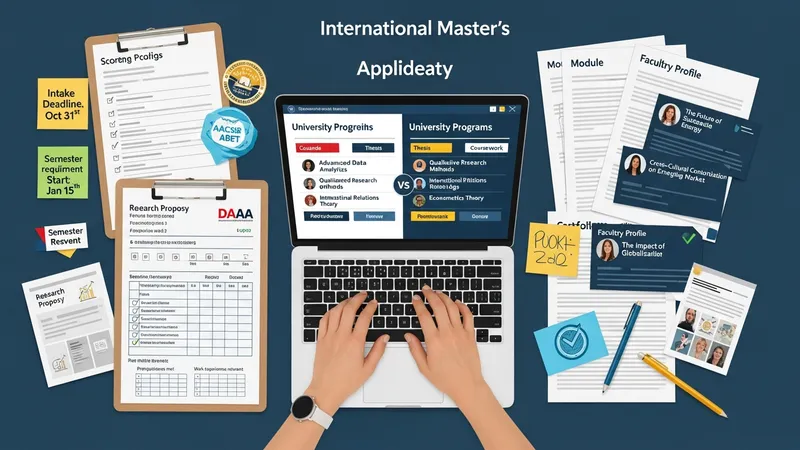
Comparing program curricula and institutional offerings is a foundational planning step. Applicants often examine course lists, thesis versus coursework balance, credit structures, and module descriptions to determine academic alignment with prior study or intended specialization. Faculty profiles and recent publications may indicate available supervision for research-oriented programs. Accreditation and recognition of the awarding institution can influence future credential acceptance, so applicants may consult institutional accreditation statements or national higher-education authorities. This research phase typically narrows a broad field of options to a manageable shortlist based on academic fit and program format.
Applicants may use a simple scoring or checklist approach to evaluate program features without implying absolute rankings. Common checklist items include prerequisite coursework, minimum grade or GPA thresholds, required work experience if any, and the presence of laboratory or field components. Some programs require a research proposal or portfolio; others emphasize coursework and assessments. Understanding these distinctions can guide which documents to prepare and how to frame prior experience in application materials. Comparative notes often include practical considerations such as semester timing and intake dates.
Course recognition and credit transfer considerations often influence selection for candidates who expect to move between systems or seek further study. Credit systems—ECTS, quarter/semester credits, or local credit scales—may convert differently across institutions. Applicants may consult program handbooks or admissions offices to clarify whether past coursework may be credited and what evidence will be required. For international candidates, verifying whether a degree is considered equivalent for professional registration or further academic study in another country can be important.
Researching student support services and campus resources may be part of program selection for those concerned about integration and academic success. Services that applicants often note include academic advising, language support centers, research training, and library access. Practical facilities—laboratories, studios, or field equipment—can matter for certain disciplines. Considering these service and infrastructure elements alongside academic content can provide a fuller view of how well a program may support an incoming graduate student.

Admission requirements vary by program and institution and often include official transcripts, certificates, a curriculum vitae, letters of reference, and a personal statement or research proposal. Transcripts may need to be issued by the awarding institution and sometimes notarized or apostilled depending on the destination. Letters of reference typically come from academic supervisors or professional managers familiar with the applicant's academic or work performance. Applicants may check whether referees are expected to submit letters through institutional portals or via sealed, signed envelopes.
Statements of purpose or research proposals are commonly used to assess fit for graduate programs and may require tailored content for each application. A research proposal generally outlines a research question, methodology, and potential supervision needs for thesis-based degrees, while a personal statement may discuss motivations and relevant background for taught programs. Some programs provide explicit prompts or word limits; applicants often align their narratives with those prompts and with the program’s stated learning outcomes.
Application timelines and deadlines differ by intake and institution. Many programs follow fixed intake dates (e.g., autumn/fall or spring), while some accept rolling applications. Applicants commonly establish reverse timelines from desired start dates to schedule test dates, document collection, and referee responses. Institutions may also offer early decision or priority review periods for certain funding or scholarship considerations, which can influence when materials should be submitted. Checking the specific application portal instructions reduces the chance of missing institution-specific requirements.
Credential verification and official document submission may take additional time beyond initial application review. Some universities accept scanned copies for initial assessment but require official originals for enrollment; others may require third-party credential evaluation services for international degrees. Translation of documents by certified translators and notarization may also be necessary. Factoring in processing and postal times for certified documents and certificates is often a practical consideration in building an application schedule.

Language proficiency requirements commonly specify accepted tests, minimum score ranges, and score validity periods. Accepted assessments may include internationally recognized tests as well as institution-specific evaluations; test acceptance can vary by program. Applicants commonly verify score reporting procedures and whether institutions allow conditional offers pending completion of language requirements. Planning test dates with adequate time for preparation and potential retakes is often recommended, given score release timelines and application deadlines.
Standardized academic tests such as the GRE or GMAT are required by some programs or fields and may be used alongside other application components. Test score use can differ: some programs rely heavily on quantitative or analytical sections, while others treat scores as one element among many. Test validity periods and report delivery methods should be checked early to ensure scores are reported within acceptable windows. Applicants may also confirm whether programs accept alternative evidence of quantitative or research skills, especially where standardized testing access is limited.
Credential evaluation services can translate and equate international academic records to the host country’s grading or credential framework. Institutions sometimes require a specific evaluation provider or accept institutional review. Evaluations typically include verification of degree level and approximate grade equivalence, which can be relevant for meeting minimum entry criteria. Applicants often check institutional guidelines to determine whether an external evaluation is necessary and how long the evaluation process may take for international records.
Timing and sequencing of tests and evaluations often influence overall application timelines. Test preparation, scheduling, and result reporting may add weeks or months, while credential evaluations and notarization can also require lead time. Applicants commonly map these processes into a master timeline and consider contingency time for delays. Understanding these timing interdependencies can reduce the likelihood of missing critical deadlines or having to defer enrollment.

Visa processes and immigration requirements vary widely by destination and may include proof of admission, financial evidence, health insurance, and medical or security checks. Processing times may range from weeks to months, so applicants often begin researching visa categories early in the application cycle. Some countries require a specific period of validated financial support documentation, while others may request evidence of fee payment or enrollment. Awareness of these requirements can inform decisions about application timing and contingency planning.
Funding and expense planning commonly influence program choices and timelines. Applicants may estimate tuition ranges and living costs, consider external scholarships or employer support, and account for additional expenses such as health insurance, visa fees, and relocation. Funding availability often varies by program and institution type; some institutions publish scholarship or assistantship information, while others maintain external scholarship databases. Planning multiple budget scenarios can help applicants assess affordability and selection preferences.
University selection factors often extend beyond academic content to include accreditation, research infrastructure, campus support services, and graduate employability indicators. Applicants may review publicly available data on graduate outcomes, internship pathways, or employer engagement where available, recognizing that such indicators may be presented differently across institutions. Considering location, language of instruction, and living costs alongside academic features can provide a more comprehensive basis for choosing programs that align with personal and professional considerations.
When planning next steps, applicants typically integrate program research, document readiness, test scheduling, and visa and funding timelines into a cohesive plan. Each component may affect the others—for example, funding timelines can affect visa readiness, and test results can influence application timing—so mapping these dependencies often clarifies priorities. Readers who continue to subsequent materials may find practical checklists and timeline templates helpful for sequencing these elements without creating undue time pressure.