
Commercial airlines typically divide passenger cabins into several tiers that correspond to differences in seating, onboard services, and fare conditions. These tiers commonly include a baseline seating category with standard space and service, an intermediate cabin that provides incrementally more legroom and amenities, and a higher-tier cabin designed for extended comfort and work-friendly layouts. The distinctions between these tiers are structured around physical seat features, the scope of in-flight services, and the associated fare rules that affect flexibility and inclusions.
The separation among cabin levels often reflects airline product strategy and aircraft configuration. Differences may appear in seat pitch and width, recline and privacy, meal service timing and quality, entertainment systems, and access to airport facilities such as lounges or priority lanes. Ancillary elements like baggage allowances, change and refund policies, and frequent‑flyer accrual rates also vary by cabin and can influence overall travel experience and perceived value.
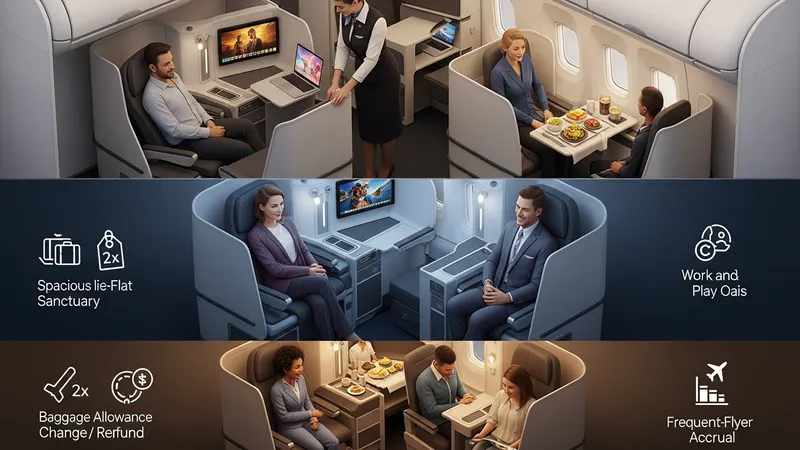
Comparing physical seat measurements is a common way to understand cabin differences. Seat pitch in standard economy may typically range from about 28–32 inches, while premium economy seats can often add several inches of legroom and more recline. Business class seats may provide substantially greater personal space and privacy, including configurations that allow full recline into sleeping positions on many long-haul aircraft. Aircraft type and airline product choices strongly influence exact dimensions and layouts.
Service scope is another axis of variation. Economy service commonly includes basic meal and beverage offerings, with larger carriers sometimes selling upgrades for extra comforts. Premium economy may provide enhanced meal presentation, wider selection of beverages, and amenity kits on longer sectors. Business class service often includes multi-course meals, expanded beverage lists, and dedicated cabin crew attention. These differences may affect passenger experience more than absolute comfort metrics alone.
Fare rules and inclusions typically differ across cabins and can shape travel planning. Economy fares often have more restrictive change and refund policies and may have additional fees for seat selection and checked baggage. Premium economy fares may include one or more checked bags and more flexible change terms, while business class fares commonly include higher baggage allowances and more lenient rebooking or refund options. Loyalty program earn rates may also vary by cabin class and fare family.
Onboard amenities and technology are additional differentiators. Economy seats may offer personal screens or shared displays depending on aircraft age; premium economy generally provides larger screens and improved headphones or power outlets; business class often incorporates larger individual monitors, direct power and data ports, and enhanced noise‑reducing headsets. Cabin lighting, privacy partitions, and storage solutions also tend to improve progressively from economy to business.
In summary, airline cabin tiers reflect a combination of seat design, service level, fare conditions, and airport benefits that together influence passenger experience. The next sections examine practical components and considerations in more detail.
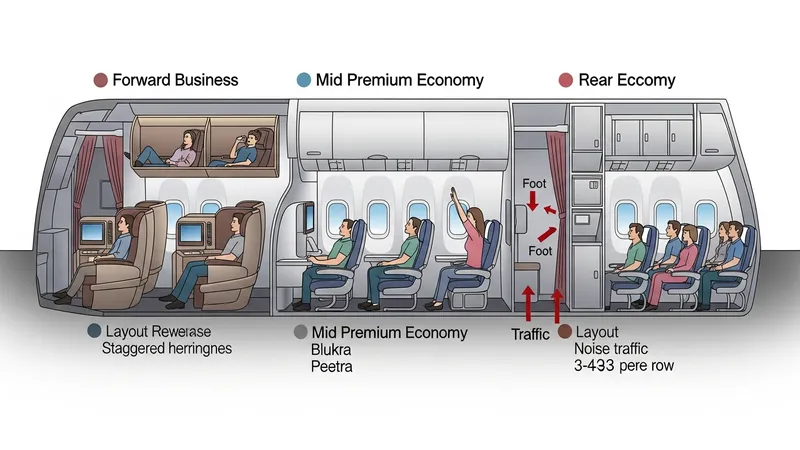
Seat geometry and cabin layout shape perceived comfort across different cabin tiers. Economy cabins are often arranged with higher seat counts per row to maximize capacity, while premium economy typically reduces seats per row or increases pitch to provide more personal space. Business cabins frequently use reverse‑herringbone, staggered, or forward‑facing suites to enhance privacy and allow flat‑bed positions on long routes. Aircraft types—single‑aisle versus wide‑body—affect whether a carrier can economically offer an intermediate cabin at all.
Configuration decisions also influence proximity to galleys, lavatories, and high‑traffic areas, which can affect noise and convenience. Premium economy sections are commonly located between economy and business cabins to balance service flows, whereas business cabins are usually forward for quicker boarding and disembarkation. On long‑haul aircraft, bulkhead rows in premium economy may offer additional legroom but sometimes limit under‑seat storage, an operational trade‑off to consider.
Manufacturers and retrofit options have expanded seating types available to airlines. Some premium economy seats add adjustable leg rests, deeper recline, and improved cushioning, while business seats may incorporate direct aisle access for every passenger on certain wide‑body models. The choice of specific seat modules and cabin density frequently depends on route demand and network planning, so similar seat classes can vary noticeably between carriers.
As a practical consideration, passengers often weigh seat measurements such as pitch, width, and recline against the duration of a flight. For medium‑haul journeys, the incremental space of premium economy may be perceived as sufficient, while for overnight long‑haul sectors the lie‑flat capabilities of business cabins may be more relevant. These preferences can guide which cabin feature differences are most meaningful for a given itinerary.
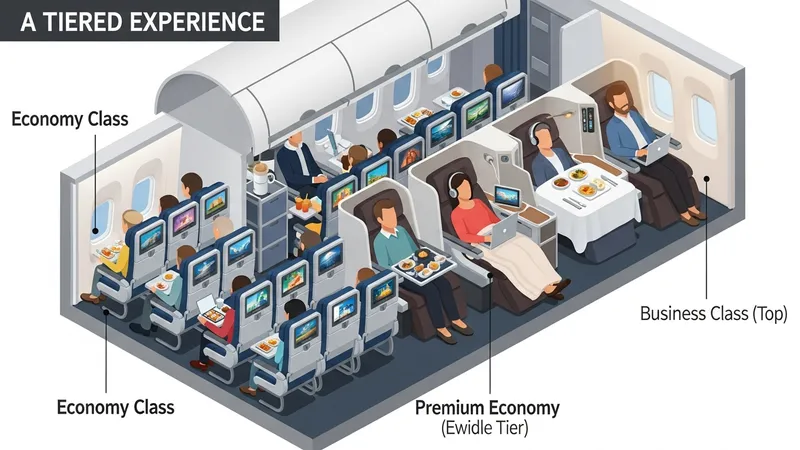
Onboard service levels typically scale with cabin tier. In economy, service often focuses on efficient distribution of meals and basic beverage options. Premium economy may introduce upgraded menu items, tableware approximating premium service, and included amenities such as improved blankets and headphones on longer flights. Business cabins commonly present multi‑course dining with flexible service timing and higher‑quality linens and amenity kits, reflecting a different service model designed for longer comfort and privacy.
Entertainment and connectivity also differ among cabins. Economy passengers may receive smaller screens or rely on shared overhead displays on some aircraft, while premium economy usually offers larger screens and, in some cases, better noise‑reducing headphones. Business class typically includes the largest personal entertainment displays, higher‑spec headphones, and more generous data or Wi‑Fi allotments where available. These variations can affect productivity or rest, depending on passenger needs.
Crew interaction patterns are often adjusted by cabin. Premium economy often receives a service approach that is more attentive than economy but less bespoke than business; cabin crew ratios in business may allow more individualized attention including amenity distribution and turndown service. The timing and presentation of meals and beverages are also arranged to fit the cabin’s service standards, which can influence the onboard rhythm for passengers across cabins.
Considerations for travelers include whether incremental amenities align with flight length and personal priorities. Improved meals and amenity kits may be more valuable on multi‑hour sectors, while high‑quality entertainment and connectivity can matter for work‑oriented travelers. These assessments may guide how cabin amenity differences are interpreted rather than implying universal value for all passengers.
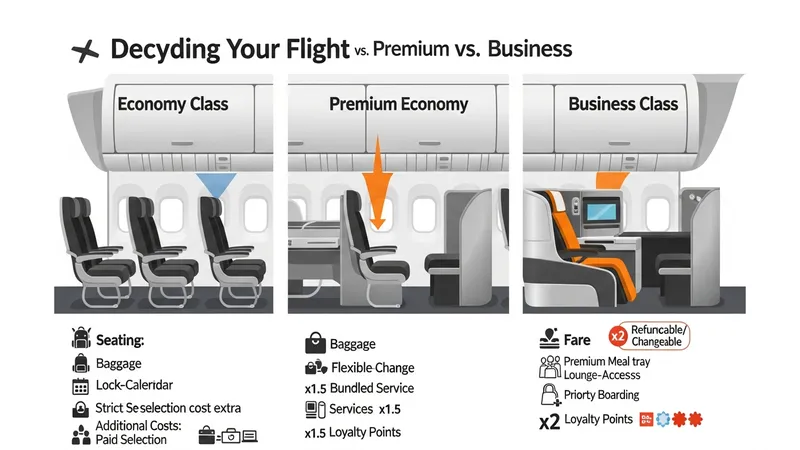
Airfare structures often reflect incremental service and flexibility. Economy fares frequently represent the lowest base fare with optional add‑ons for seat selection and baggage, and may carry stricter change or refund conditions. Premium economy fares are typically higher than economy and may include bundled services such as one or more checked bags and greater change flexibility. Business fares usually command a significant premium and often include more flexible rebooking and refund terms as part of the fare family.
Loyalty accrual and elite status recognition can vary by cabin and by fare subclass. Many frequent‑flyer programs award higher mileage or points multipliers for premium economy and business cabins compared with economy, and elite benefits such as lounge access or priority boarding are more closely aligned with business class tickets or higher fare buckets. Program rules are carrier‑specific, so the cabin label alone does not uniformly determine accrual rates or privileges.
Revenue management strategies mean that published fares for the same cabin can vary widely by season, route, and advance purchase. Airlines may offer promotional or discounted premium economy fares on select routes, while business class pricing often responds to corporate demand and high discretionary spend. These market dynamics create overlap at times, where premium economy fares on long‑haul sectors approach or, in promotional circumstances, briefly align with discounted business fares.
When evaluating fare tiers, consider the combination of included services, change flexibility, and loyalty treatment rather than price alone. For some travelers the fare rules and baggage inclusions of an intermediate cabin can provide sufficient operational advantages without the higher cost associated with a fully premium cabin, depending on itinerary and personal priorities.
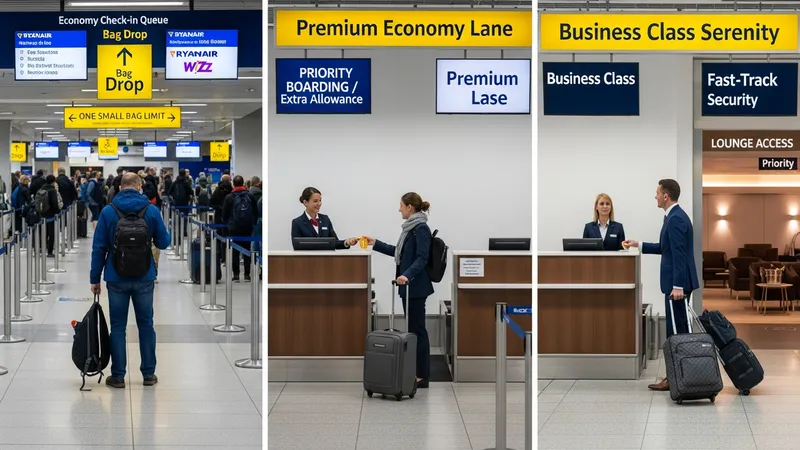
Baggage policies typically scale with cabin level, though implementation varies by carrier and fare family. Economy fares may include only carry‑on by default on some low‑cost or basic economy products, while standard economy often includes at least one checked bag on traditional carriers. Premium economy generally increases checked baggage allowance relative to economy, and business class commonly permits larger or additional checked pieces. Exact weight and piece limits depend on airline rules and route classifications.
Access to airport facilities is another differentiator. Business class passengers frequently receive lounge access, priority security and boarding, and dedicated check‑in counters, which can shorten processing times and provide quieter spaces pre‑departure. Premium economy travelers may sometimes receive priority boarding or extra check‑in benefits depending on the carrier, but access to premium lounges is less often included. These facility differences can affect the door‑to‑gate portion of travel more than in‑flight comfort alone.
Travel experience considerations include sleep quality, work capability, and recovery on arrival. Business cabins with lie‑flat seats and greater privacy may aid rest on overnight flights, while premium economy’s additional legroom and recline can improve comfort on daytime long sectors. Economy seating outcomes depend heavily on duration and aircraft; short‑haul economy may be functionally adequate for many regional trips, whereas longer flights often highlight the ergonomic advantages of upgraded cabins.
Operational factors such as aircraft type, route length, and seat availability can influence the practical differences among cabins. For example, some single‑aisle aircraft do not offer a distinct premium economy product, constraining options on certain short‑ or medium‑haul routes. Travelers and planners may therefore assess cabin features in the context of specific flights rather than assuming uniform offerings across carriers or fleets.
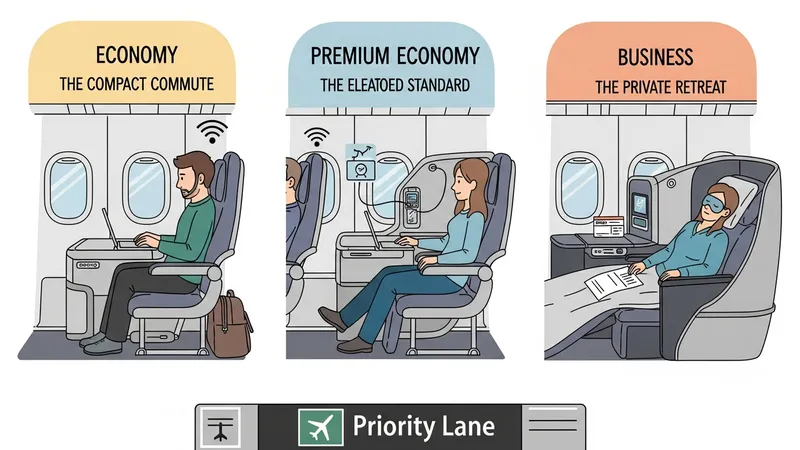
Determining which cabin attributes matter often depends on itinerary length, work needs, and personal comfort priorities. For flights under three hours, the marginal benefits of premium cabins may be less pronounced, whereas overnight long‑haul travel tends to highlight differences in lie‑flat capability and privacy. Considerations such as the need for uninterrupted sleep, the requirement to work with laptop power and stable Wi‑Fi, and the importance of quicker airport processing can influence which cabin features are most relevant.
Flexibility and disruption resilience are also part of the assessment. Higher fare classes commonly include more flexible change policies and priority during irregular operations, which can reduce downstream travel stress. However, airline policies and fare rules differ substantially, so evaluating the fare conditions attached to a ticket can clarify the practical trade‑offs between cost and operational robustness for a given journey.
Seat selection and timing matter operationally: seats near bulkheads may afford more legroom but can have restricted storage, while aisle seats facilitate movement but may allow more foot traffic. Cabin location relative to galley and lavatory positions can affect noise and service interaction. These granular factors can alter perceived cabin quality independent of the overall cabin label, so reviewing seat maps and product descriptions may be informative when evaluating specific flights.
In closing, the distinctions among the common cabin tiers reflect a blend of physical seating, service design, fare structure, and airport benefits. Assessing which combination of features aligns with travel objectives and comfort needs may help in understanding how incremental cabin options differ in practice. The article’s earlier sections introduced these components and the final analysis here is intended to support further examination of specific carrier offerings and route‑level configurations.